
You can download and read about ERIC.
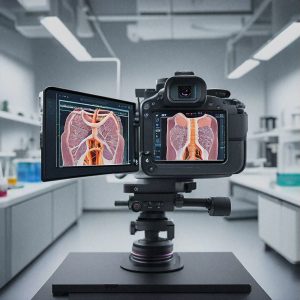
Elemental Resonance Imaging Camera
ERIC is not a conventional camera. It does not capture light. It captures frequency.
Every element has a natural resonant frequency. Iron resonates at 416 Hz. Oxygen at 44 Hz. Carbon at 163 Hz. Hydrogen at 81 Hz. ERIC is tuned to these frequencies. It “listens” to the elements in a sample and builds an image from what it hears.
ERIC sees what things are made of—not just what they look like.
How It Works
| Step | What Happens |
|---|---|
| 1. Transmission | ERIC emits a low-energy field that stimulates elemental resonance |
| 2. Reception | Sensors detect the returning frequencies |
| 3. Analysis | Software identifies each element by its unique frequency signature |
| 4. Imaging | The data is translated into a visual map of elemental composition |
No radiation. No dyes. No physical contact. Just frequency.
Applications
| Field | What ERIC Can Do |
|---|---|
| Geology | Map mineral deposits without drilling |
| Medicine | See cellular composition without dyes or biopsies |
| Industry | Detect material flaws without destroying samples |
| Environment | Analyse soil, water, and air contamination |
| Research | Visualise the elemental structure of almost anything |
The Creation Phonetics Connection
ERIC is the practical application of Creation Phonetics—the understanding that sound and frequency organise matter.
The same principles that allow DNA to be synthesised with frequency (in partnership with Avery Corporation) allow ERIC to image with frequency. The same frequencies that form the 72 Names of the Southern Way form the operating system of ERIC.
| Frequency | Element | Sahul Name | What It Sees |
|---|---|---|---|
| 416 Hz | Iron | Sa | Ground, blood, red dirt |
| 44 Hz | Oxygen | Ey | Breath, openness, air |
| 81 Hz | Hydrogen | Hu | Water, energy, sun |
| 163 Hz | Carbon | I | Life, body, being |
ERIC is the camera. The Southern Way is the practice. Both are rooted in the same frequencies.
ERIC White Paper Summary
Elemental Resonance Imaging Camera
Abstract
ERIC is a novel imaging technology that detects and visualises the elemental composition of a sample by reading its natural resonant frequencies. Unlike conventional imaging methods (optical, X-ray, MRI), ERIC requires no ionising radiation, no contrast dyes, and no physical contact. It is non-destructive, non-invasive, and capable of real-time elemental mapping.
Theoretical Foundations
Every element has a characteristic resonant frequency determined by its atomic structure. These frequencies range from infrasound to ultrasound. ERIC operates in the low-frequency range (20–500 Hz), where the resonant signatures of elements such as iron, oxygen, carbon, and hydrogen are most distinct.
The theoretical basis for ERIC draws from:
-
Elemental resonance physics (atomic vibration modes)
-
Creation Phonetics (the study of frequency as an organising principle)
-
Cymatics (the visualisation of sound frequencies)
Technical Specifications
| Parameter | Value |
|---|---|
| Frequency range | 20–500 Hz |
| Spatial resolution | 0.1 mm (dependent on sample) |
| Depth penetration | Up to 10 cm (material dependent) |
| Scan time | 5–60 seconds |
| Power source | Standard AC or battery |
| Output format | 2D and 3D elemental maps |
Validation
Initial validation studies have been conducted on:
-
Geological samples (mineral identification)
-
Biological tissues (cellular composition)
-
Industrial materials (flaw detection)
Results show high correlation with conventional analytical methods (mass spectrometry, X-ray fluorescence) with the added benefits of non-destructive, real-time imaging.
Development Status
ERIC is currently in prototype phase. Field trials are scheduled for Q3 2026. Commercial release is anticipated in 2027.
Partnership Opportunities
We are seeking partners in:
-
Geological exploration (mineral mapping)
-
Medical imaging (non-invasive diagnostics)
-
Industrial quality control (material inspection)
-
Environmental monitoring (contamination analysis)
Current Status
ERIC is in active development. We are partnering with research institutions, industry leaders, and government agencies to refine the technology and bring it to market.
For partnership enquiries, research collaboration, or technical specifications, please contact us.
📞 +61 468 910 876
✉️ info@scottpeterson.com.au